Nomination Policy and Procedures
When nominating candidates for directors (excluding directors who serve on the Audit and Supervisory Committee), our policy is to select individuals who possess extensive knowledge and experience in their respective business areas, can make significant contributions to both their business areas and the Company’s management, are capable of fulfilling their duties as directors, and can contribute to enhancing corporate value. When nominating candidates for Audit and Supervisory Committee members and outside directors, our policy is to select individuals who possess highly specialized knowledge in various fields, as well as broad experience and insight, and from whom we can expect active advice at Board of Directors meetings and other forums. Regarding the appointment procedure, the Board of Directors recommends candidates who meet these criteria; the Nomination Committee—composed of a majority of independent outside directors—deliberates on these recommendations; the Board of Directors then finalizes the list of candidates, which is submitted as a proposal to the General Meeting of Shareholders for approval. If the Board of Directors determines that a director does not meet the requirements set forth in the above appointment policy, the Board will deliberate on the dismissal of that director following deliberation by the Nomination Committee, and a decision will be made at the General Meeting of Shareholders in accordance with the Rules of Procedure for Directors.
Reasons for Appointment as Directors
As of April 2026
Directors
Outside Directors
Skills Matrix
As of April 2026
Effectiveness Assessment
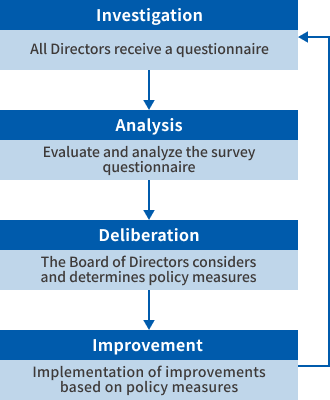
The Company conducts an analysis and assessment of the effectiveness of the Board of Directors as a whole (Board of Directors Effectiveness Assessment) once a year from the end of March to May, the end of our fiscal year, in order to further improve the composition and operation of the Board of Directors in the future.
For the analysis and assessment method, all Directors complete an anonymous self-assessment questionnaire that references information from other companies and external insight. The content of the analysis and assessment is reviewed by the Board of Directors once responses are received from all participants.
In the analysis and assessment for FY 2024, the composition, size, and operation of the Board of Directors, cooperation with auditing organizations, and relations with shareholders and investors were assessed positively, and that a governance structure similar to that of FY 2023 was being maintained, leading to the analysis and assessment that the Company’s Board of Directors is fulfilling the role expected of it in an appropriate manner and has ensured sufficient Board effectiveness.
In light of expectations for a revision of standards for agenda to be submitted to the Board of Directors, we will take a focused and detailed approach in exploring these suggestions as we continue to work to increase the effectiveness of the Board of Directors.
Director Training
In addition to having newly appointed Directors, including Audit and Supervisory Committee Members, undergo external training in order to enhance their knowledge, the Company also provides opportunities for knowledge acquisition after they have been appointed, such as by holding study meetings with external specialists to address revisions to laws.
In order to ensure that the necessary knowledge is acquired by each operations division, the Company encourages appropriate participation in various external seminars, etc.
Independence Criteria for Outside Directors
The Company has established the following independence standards for appointing Outside Directors.
Independent Director Notification Form[PDF:68KB]
Directors
| Maximum Number of Directors Stipulated in Articles of Incorporation |
22 |
| Term of Office Stipulated in Articles of Incorporation |
1 year |
| Chairperson of the Board of Directors |
President |
| Number of Directors |
17 |
| Appointment of Outside Directors |
Appointed |
| Number of Outside Directors |
6 |
| Number of Independent Officers Designated From Among Outside |
6 |
Director remuneration
As of March 2026
Basic policy
Our basic policy for remuneration for the Company’s Directors (excluding Outside Directors and Directors who are Audit and Supervisory Committee Members) is to maintain a remuneration system designed to function sufficiently as an incentive to continuously improve corporate value and to ensure appropriate remuneration based on the individual Director’s job responsibilities when determining their remuneration.
Composition of director compensation
Director remuneration is comprised of a basic remuneration paid monthly, a director bonus paid at a certain time each year, and restricted share-based remuneration. The basic remuneration is comprised of a rank-based salary and a position-based salary based on their position and tenure as well as their contribution to business, and a performance-based salary determined according to their individual evaluation. Director bonuses are performance-linked remuneration, with individual net income for the period used as the main indicator. The reason we adopted this indicator is because it indicates final performance figures for the fiscal year in question, and as such, we found it to be the most reasonable standard for the basis of calculating performance-linked remuneration. Restricted share-based remuneration is given in accordance with each Director’s position and tenure, etc. from the perspective of providing incentive regarding improving long-term corporate value.
Remuneration for Outside Directors and Directors who are Audit and Supervisory Committee Members is comprised of a basic remuneration paid monthly and is fixed to maintain objectivity and fairness.
| Types of remuneration |
Calculation method |
| Basic remuneration |
Individual evaluation of business performance, contribution to company management, etc. |
| Performance-linked remuneration (bonuses) |
Individual net income for the period used as an indicator |
| Restricted share-based remuneration |
Granted according to position and tenure |
Total Remuneration of Directors and Audit and Supervisory Committee Members
Determination process for director remuneration
The policy on determining the details of individual remuneration, etc. for Directors of the Company is determined by a resolution of the Board of Directors after consulting the Remuneration Committee, of which the majority are independent Outside Directors, prior to the Board of Directors meeting. Based on the policy for determining individual remuneration, etc. for Directors, the Remuneration Committee carefully deliberates on and determines individual remuneration, etc. for Directors (excluding Directors who are Audit and Supervisory Committee Members) in consideration of company performance and other indicators within the range of the total remuneration resolved at the General Meeting of Shareholders. Remuneration for Directors who are Audit and Supervisory Committee Members is determined by a deliberation by Directors who are Audit and Supervisory Committee Members within the range of the total remuneration resolved at the General Meeting of Shareholders.
Succession Plan
The Company has established the “Basic Policy on Company President Succession Plan.”
In the selection of the President’s successor, the Representative Directors will recommend a candidate to the Board of Directors at an appropriate time from among the successor candidates who have been developed over the medium to long term. The Board of Directors will then consult the Nominating Committee regarding the recommended candidate. The Nominating Committee, primarily composed of Outside Directors, engages in thorough discussions by incorporating independent perspectives, broad viewpoints, and managerial insights from Outside Directors with management experience, and submits its findings and recommendations to the Board of Directors. The Board of Directors, upon receiving the recommendations from the Nominating Committee, conducts final discussions and makes the decision on the appointment of the President.
In FY 2025, the progress of the succession plan and future initiatives based on the Basic Policy were discussed by the Board of Directors following deliberations by the Nominating Committee, which is primarily composed of Outside Directors.
Selection Process
1.Selection of successor candidates
Multiple successor candidates are selected from among individuals who are capable of practicing the Company’s management philosophy and possess extensive knowledge and experience, regardless of nationality, race, gender, career history, or age.
2.Development of candidates
Development plans are formulated for the multiple successor candidates to allow them to gain experience in challenging operations on the ground and management on a daily basis, both within the Company and at Group companies, so that they are systematically developed over an adequate period of time with the necessary resources.
3.Narrowing down of final candidates
The Representative Directors recommend a candidate to the Board of Directors at an appropriate time from among the successor candidates who have been developed over the medium to long term. The Board of Directors then consults the Nominating Committee regarding the recommended candidate.
4.Evaluation by the Nominating Committee
The Nominating Committee engages in thorough discussions by incorporating independent perspectives, broad viewpoints, and managerial insights before submitting its findings and recommendations to the Board of Directors.
5.Decision by the Board of Directors
The Board of Directors, upon receiving the recommendations from the Nominating Committee, conducts final discussions and makes the decision on the appointment of the President.