Optimizing support through menu development and food procurement
Menu development and food procurement are the pillars of supporting the business sites. We support the food services of each business site across the nation based on the characteristics of the businesses.
Menu development
With meeting customer expectations as our starting point, we incorporate traditional Japanese dishes, food for special occasions, and seasonal ingredients, and offer menus that give customers a sense of the changing seasons while also factoring in our operational structure on the frontlines. This embodies our commitment to food. In reinforcing our operational system on the frontlines, we also take into account kitchen equipment and workflow conditions, offering a wide range of support from menu design that prioritizes work efficiency and the formulation of cooking standards to proposals for kitchen equipment, engaging in collaborative menu development with the frontline staff.
Food procurement
Valuing our links with designated suppliers across Japan, we have erected a system to reliably deliver necessary ingredients to each business site every day while prioritizing “high quality at low cost” and “continuous, stable procurement.” To address the surging cost of ingredients, we used centralized purchasing that leverages economies of scale to curb intermediary costs. For the purpose of securing a stable supply of ingredients, we established a traceability system and tackled the prompt switching to alternative ingredients in response to supply shortages. Furthermore, with a view to future business expansion, we are also moving forward with building a new distribution model in collaboration with our business partners.
Develop menus tailored to the characteristics of the business based on our food culture and health consciousness
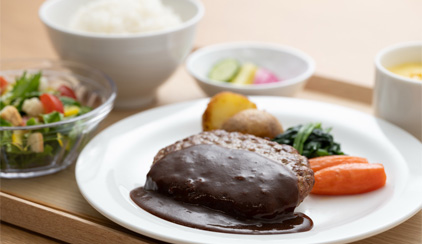
Dormitory Business
Meals with good nutritional balance centered on home-style cooking that residents will not be tired of

Dormy Inn Business
Local specialty unique to the region and freshly cooked egg cuisine
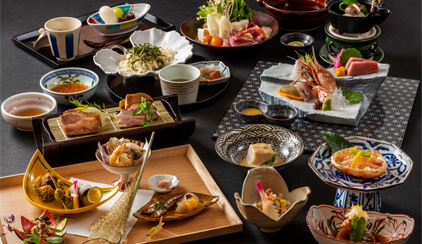
Resorts Business
Memorable cuisine using local ingredients
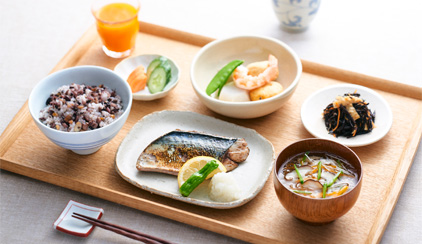
Senior Life Business
Meals that aid chewing, help increase chewing power, and support health
Foods Specialists
Starting in FY 2022, we have established the Foods Specialist category in the course-based human resources system to provide a clear roadmap for food professionals. To enable our employees to actively work towards achieving a common goal, we have formulated a “MISSION,” “VISION,” and “VALUE” based on wisdom and techniques founded on experience up to this point. By building a foundation for human resources training, we are working to enhance the organizational capability and foster next-generation successors through appropriate leadership, clear communication, and maximization of individual talents.
Formulating & Instilling Our Vision
We have formulated a new vision for Foods Specialists that incorporates the practice of devotion to each meal into behavioral evaluations.
Introduction of “Skill Evaluations” to Boost Expertise
To boost expertise as Foods Specialists, we have introduced skill evaluations that divide the skills required of Foods Specialists into four categories: (1) Menu development, (2) Sanitation, (3) Opening business, and (4) Food procurement, with evaluation criteria set by grade.
Furthermore, we have introduced a Technical Master Certification as a practical test, and are working to emphasize that the goal is not simply to pass the test but also understand one’s own strengths and weaknesses accurately.
Career Model
To provide greater opportunities for growth as food specialists, we are enhancing training programs tailored to each grade level. In addition, we offer skill allowances for those who obtain national qualifications or certifications, and have established a dedicated support system to assist food specialists in acquiring relevant credentials.
Assigned to the Menu Development Department, Foods Division
Responsible for kitchen operations at senior care facilities, including cooking, plating, and kitchen hygiene management.
Transition from On-Site to Head Office Assignment
Engaged in food ingredient ordering for dormitory facilities, hygiene inspections at sites, kitchen staff training at facilities, and recipe testing at an annex.
Gained understanding and insight into head office operations related to site management.